
How to Write a Letter to Your Future Self: Prompts, Examples and Where to Send It
· By Veronica West
A letter to your future self is a message you write now and open on a date you choose, so the person reading it can compare today with what happened next.
Write it in six steps: choose a date, describe an ordinary day, name a hope, ask two questions, write the reply, then seal it. One page is enough. Send it as a free email or a printed postcard.
Jump to: prompts · examples · 10 pieces of advice · where to send it

Why write a letter to your future self?
A letter to your future self can strengthen your connection to the person who reads it; small studies link that to follow-through.
Psychologists call that connection future self-continuity: how similar, and how real, the person you will be feels to the person you are now. A few studies have used letters to test it:
- Exercise: in one experiment, people were asked to write a letter to themselves three months or 20 years ahead. Those whose sense of connection to their distant future self grew exercised more in the following days (Rutchick and colleagues, 2018).
- Writing the reply: in a study with students, those who sent a letter to their future self and also wrote the reply, as their future self, showed larger increases in connection to their future self, career planning and willingness to wait for a reward than those who only sent it (Chishima and Wilson, 2020).
- Why detail matters: a review by Hal Hershfield (2011) found that people make more future-minded choices when their future self feels similar to who they are now, vivid and positive.
These are small experiments, mostly with students, measuring short-term effects. A letter is not a treatment, and these findings come from the studies' published summaries. Still, they point to something most people notice anyway: writing to a specific future you makes that person easier to picture.
There are everyday reasons too:
- A record of an ordinary day, the part of life nobody photographs.
- A checkpoint on a goal, a move or a decision, read when you can see how it turned out.
- A kind note from you to you, for a year you can't see yet.
How to write a letter to your future self, step by step
You write a letter to your future self in six steps: choose the date, describe today, name a hope, ask questions, reply, seal.
- Choose the opening date first. It decides who you are writing to: the you of next year writes back to different worries than the you of ten years. If you're unsure, choose one year.
- Start with today. The date, the place and three ordinary details: a price, a song, a person you spoke to.
- Say what you hope for and what worries you. Write hopes as "I would like", not as deadlines.
- Ask two or three questions only the future you can answer.
- Write the reply you hope to hear. Three to five lines, written as your future self. It's optional, but it is the step the student study above found made a difference.
- Close kindly, sign it with your age and the date, seal it, and tell one person where it is.
One page is enough, and it takes about 20 minutes. If you can, put it away for a day and reread it before you seal it, as the University of Edinburgh's reflection toolkit suggests.
Avoid four things: a letter that is all goals and no daily life; a to-do list; promises you don't mean; and passwords or other people's private details.
How to start: opening lines
Start with facts, not feelings. The facts are what will surprise you most when you open it.
- "Dear future me, it is [date] and I am writing this at [place]."
- "Hello again. If you are reading this, [number] years have passed, and I wonder what is still the same."
- "[Date], [place], [weather]. The first thing on my mind is..."
- "I am sealing this before I change my mind."
- "A letter for [opening date]. Here is what is going on."
How to end: closing lines
End with something warm and something to do. Sign with your name, your age and the date.
- "Be kind to the person who wrote this. I was doing my best."
- "Write back to me, even if only in your head."
- "You don't have to have done it all. I would like you to have kept hold of [one thing]."
- "See you on [opening date]."
- "P.S. Look at the photo again and remember [detail]."
- "[Name], aged [age], [date]."
A P.S. works as a second job for the reader: a photo to look at, a person to call, a place to go back to.
What to include in a letter to your future self
A letter to your future self works well with ordinary detail: today's date, one worry, one hope and one question.
A checklist of eight:
- The date and place you are writing from.
- Three ordinary details: a price, a song on repeat, what you had for lunch.
- One hope, written as "I would like".
- One worry, named plainly.
- Two questions for your future self.
- One thing to remember, such as a person, a phrase or a moment.
- One permission to change your mind: "You don't have to still want this."
- A photo of right now, printed or attached.
Concrete detail is the point. Hershfield's review found that a future self who feels vivid and similar to you is easier to act for, and detail is what makes the person on both ends of the letter real. "I am happy" tells future you little; "I'm writing at the kitchen table, the heating is broken and I've just booked the train to see Mum" tells them everything.
Leave out what will age badly or cause harm: passwords and bank details, other people's secrets, and anything you would be upset to have found by someone else before the opening date.
Letter to your future self prompts for every situation
Match the prompts for your letter to your future self to its opening date: one year, five, ten, New Year, a change or school.
Pick three to five prompts from one group and answer them in full sentences. You don't need all of them.
One year ahead
For a letter you will open in twelve months, about habits, plans and people.
- Which task have I moved to next week three times, and what is my honest reason?
- Which one habit am I trying to start, and what will I do on the day I miss it?
- Who have I spoken to most this month, and who have I not spoken to for too long?
- What am I looking forward to in the next three months, and what am I dreading?
- Which sentence in this letter do I expect you to disagree with?
Five years ahead
For a letter you will open in five years, long enough for a home, a job or a city to change.
- Describe the place I live in now: the room, the street, the noise. What will you have swapped?
- Write down three prices (rent or mortgage, a weekly shop, a coffee) so you can laugh or wince.
- Which friendship needs work, and what is my plan?
- Which skill do I want to be able to say I have, and what is my first lesson?
- Which "someday" plan do I expect you to have done, dropped or forgotten?
Ten years ahead
For a letter you will open in a decade, about the big picture.
- List five things that feel normal today and might look odd in ten years: devices, prices, slang, rules.
- How old are the people I love? Give one detail of each that I would miss if it changed.
- Which advice from older people am I ignoring, and why?
- Write one promise I want you to keep and one I release you from.
- What would make ten years feel well spent, in one sentence?
New Year
For a letter written at New Year and opened at the next one. A letter written in January can be set to open in December, on New Year's Eve.
- Describe one moment from this year as a scene: where, who, what was said, in five sentences.
- What am I glad is ending?
- Which of my resolutions will you drop first, and what would help me keep it?
- What is one thing I will start this week, rather than stop?
- Write the first line of the reply I hope you send me on New Year's Eve next year.
For a family version with a jar, questions and a printable, see our New Year's Eve time capsule guide, with its jar questions and printable. To get your resolutions back by email in March, June or December, use the free resolutions reminder.
Before a big change
For a letter written before a move, a new job, a birth, a breakup or an operation, opened once the change has settled.
- What am I afraid of losing, and what do I want to carry across?
- What do I not know yet that I wish I could ask you?
- Write the sentence I will need on a hard day. Mark the envelope "open when it is hard".
- What would I say to a friend in my position?
- What would count as "all right" by the time you read this, rather than "great"?
Go gently. If writing about a hard time gets heavy, stop and come back to it another day. A letter is not a treatment; if you are struggling, talk to someone you trust.
For students or school
For a letter written in class or at the start of a school year, opened at the end of the course or on leaving.
- What am I studying, and what made me choose it?
- Which subject or task worries me most, and what is one thing I will do about it this week?
- Describe my friends and a normal lunchtime.
- What do I want to be good at by the time I read this?
- Who has helped me most this year, and have I told them?
School email addresses often stop working when you leave, and some block outside senders: FutureMe's own page asks users with a school email to ask their teacher to use its school version. Use a personal or parent's email instead, or a printed card sent to a home address. Teachers: pick one opening date for the whole class.
Letter to your future self examples: short, medium and long
A letter to your future self can run 50 words or 250; the examples below show a one-year, five-year and ten-year version.
A short letter (about 50 words)
Dear future me,
It is 2 January, I am on the sofa and my tea has gone cold. I want to be running twice a week by summer. If you still are, treat yourself. If not, no lecture: go out tomorrow. Is the kitchen sorted yet?
See you next December.
Sam, aged 34
Why it works: one goal, one ordinary detail, one question, and a kind way out. It fits on the back of a postcard.
A five-year letter (about 120 words)
Dear future me,
Today is a wet Tuesday in March and I have just signed for a one-bedroom home forty minutes from everyone I know. The rent is more than I planned. I am writing at the kitchen table, which is also my desk, my dining room and my shoe rack.
Three things I am unsure about: whether this job is the right one, whether I will find a friend here, and whether I will ever cook anything besides pasta.
Questions for you: Did you stay? Who do you phone when something goes wrong? What did you stop worrying about?
Whatever happened, I would like you to remember that I made this move on purpose.
Jo, aged 31, 14 March
Why it works: the room is described, the worries are named, and the last line gives future you something to hold on to whatever happened.
A ten-year letter (about 250 words)
Dear Alex at 38,
It is the last Sunday in June. I am on the balcony, the neighbour's radio is on, and so is the plant you have definitely killed by now.
Things that feel normal and may look odd: I pay for almost everything by tapping my phone. A coffee costs about the same as a sandwich. Everyone I know is in three group chats. Tell me which of those are gone.
Where I am: a job I like but don't love, a home I share with Mina, parents who still drive up every other weekend. Dad has started telling the same story twice. Please tell me you visited more than you thought you would.
What I want: to be someone who writes back to people. To have one skill that feels like mine. To stop choosing the safe option every time.
What scares me: that ten years will pass like the last two did, in a blur of Tuesdays.
Two promises: keep one friendship alive that takes effort, and spend one day a year doing nothing useful. One I release you from: you don't have to still love running.
Questions: Who are the five people you talk to most? What do you wish you had started sooner? Was I right about the job?
Be kind to the person who wrote this. I was doing my best.
P.S. Look at the photo. That afternoon is the part of this month I would keep.
Alex, aged 28, 29 June
Why it works: it records what will date, names what matters and what scares, makes and releases promises, and ends with questions and a photo.
Copy the shape, not the words.
10 pieces of advice for my future self
Ten pieces of advice for your future self: judge past choices by what you knew then, keep one friendship alive, book the appointment.
- Judge past choices by what you knew then. You were deciding with less information than you have now.
- Reply to the message you have been avoiding. It is usually quicker to answer than to carry.
- Book the appointment you keep putting off. Doctor, dentist, accountant: today's you has already paid for the worry.
- Write down one thing you learned each month. You forget faster than you expect.
- Keep one friendship alive that takes effort. Easy ones look after themselves.
- Tell people what you are grateful for, out loud. It costs one sentence.
- Keep one thing that has no goal. A walk, a song, a plant.
- Start the small version today. Waiting to feel ready delays things more than doing them badly.
- Ask for help earlier than you think you should. It is cheaper at the start.
- Open this letter on the day, even if it's embarrassing. Then write the next one.
Swap any line for one that fits your life. Advice in your own words is the advice you will listen to.
How long to wait before opening your letter
If you're unsure when to open a letter to your future self, choose one year; use five years for a change, ten for the big picture.
| Opening | Good for | Note |
|---|---|---|
| 1 to 3 months | A new habit, job or course | The shortest FuturePosts opening is 1 month |
| 6 to 12 months | Resolutions, a decision, the first year of something | New Year to next New Year's Eve: choose December |
| 5 years | A change of job, city or relationship | Far enough for life to change, close enough to feel real (University of Edinburgh reflection toolkit) |
| 10 years | The big picture | The longest FuturePosts opening |
| A milestone | A birthday, graduation or retirement | Add a backup date in case the milestone moves |
There is no proven best wait: the exercise study above used three months and 20 years and doesn't name an ideal. If you send your letter with FuturePosts, you choose a month from 1 month to 10 years ahead; the capsule opens at 00:00 UTC on the last day of that month, and a printed card is posted to arrive within that month.
On the day, reread it, answer your own questions, and write the next one. However you send it, set a calendar reminder and tell one person the date.
Where to send or keep your letter: drawer, email or printed postcard
You can keep a letter to your future self in a drawer, schedule it by email, or post it as a printed postcard.
| Paper letter in a drawer | Email scheduler (such as FutureMe) | FuturePosts Email Postcard | FuturePosts printed postcard | |
|---|---|---|---|---|
| Cost | Paper, and a stamp if you post it | Varies by service; FutureMe's Premium upgrade adds images, videos and files | Free | From €7, free worldwide shipping |
| How it finds you | You have to remember where it is | Emailed on the date you pick | Opens online and lands in your inbox in your opening month | Posted to arrive in your opening month; the online capsule opens on the last day of that month |
| How far ahead | Any time | Varies by service | 1 month to 10 years | 1 month to 10 years |
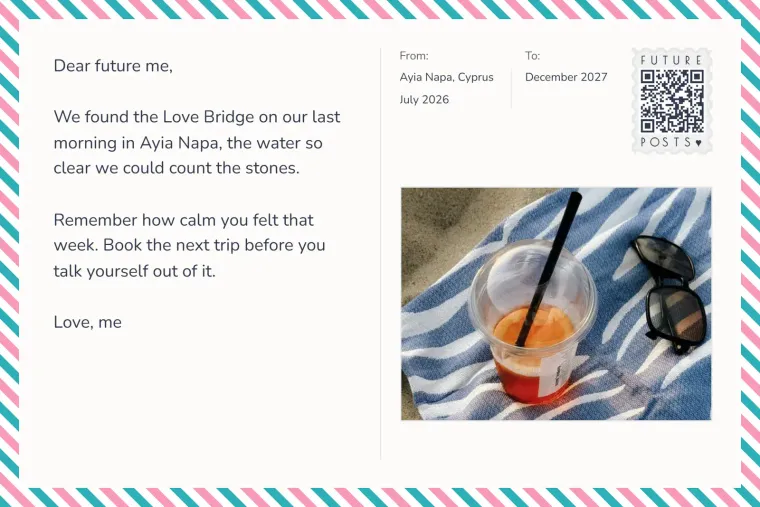
| Something to hold | Yes, but it can be lost in a move | No | No | Yes: your photo on the front, your message and postmark on the back (A5, 148 × 210 mm) |
| Length | Any | Varies by service | No word limit | No word limit: what fits prints on the card, and the full message is kept online |
| Privacy | Whoever finds it | FutureMe lets you choose private or public but anonymous; check each service's terms | No account; a private link to your confirmed email; encrypted when uploaded | Same as the Email Postcard |
| Main risk | Lost, damaged or forgotten | A changed email address or the spam folder | Can't open sooner than 1 month; opens on the last day of the month | Needs a postal address that will still work |
How to choose: keep it on paper if you want it offline and free; use an email scheduler if you want it quick and don't need a photo; use FuturePosts if you want your photo on it and, for a printed card, something to hold.
A few details about FuturePosts. No one at FuturePosts looks inside a sealed capsule, except to print your card or in the exceptional case of a legal concern. While a capsule waits, you get a check-in email about once a year so a changed address is caught early, and you can change the delivery address until printing starts on the 1st of your opening month. If you move often, send the card to a parent's or friend's address. A Classic FuturePost can also be a gift, posted to someone else's address. After opening, you can download your card as a printable PDF, and the capsule stays online for a year, longer if you extend it. For the full picture, see how the tiers, privacy and opening day work, or start a free Email Postcard.
Writing from a trip? See our guide to mailing a postcard to yourself from a trip.
Is writing a letter to your future self free?
Writing a letter to your future self costs nothing on paper, and the FuturePosts Email Postcard is free; printed postcards start at €7.
- Paper: free, plus a stamp if you post it to yourself or to a friend to keep.
- Email schedulers: many let you write a basic letter without paying. FutureMe, the best-known one, offers a Premium upgrade to add images, videos and files; check its current terms for what's included.
- FuturePosts: the Email Postcard is free and includes your photo, your message and a postmark. A printed postcard from €7 adds the card itself, with free shipping worldwide. A voice recording or extra photos need one of the vault options.
What free doesn't cover: with any email option, nothing is printed and there is nothing to hold on the day it arrives.
Write your letter today
Start your letter to your future self with the free Email Postcard, then add a printed card if you want something to hold.
- Choose the date.
- Pick three prompts from one group above.
- Write for 20 minutes, then seal it.
Writing at New Year? The resolutions reminder sends your resolutions back in March, June or December. For more ideas, browse more time capsule ideas.
Questions about writing a letter to your future self
These answers cover meaning, openings, content, cost and privacy for a letter to your future self.
What does it mean to write a letter to your future self?
It means writing to the person you will be on a chosen date, then not reading the letter until that day. You describe your life now, say what you hope and fear, and ask questions. On the day, you compare the letter with what actually happened.
How do I start a letter to my future self?
Start with facts: "Dear future me, it is [date] and I am writing this at [place]." Then add three ordinary details, such as a price, a song and a person you spoke to today. Facts date well and are the part that surprises you most later.
What can I write in a letter to myself?
Write about an ordinary day, one hope, one worry and two questions you want answered. Add one thing to remember and permission to change your mind. If you get stuck, use the prompts for one, five or ten years ahead.
What should I include in a letter to my future self?
Include the date and place, three ordinary details, one hope, one worry, two questions, one thing to remember, permission to change your mind, and a photo of right now. Leave out passwords and other people's private details.
What are 10 pieces of advice for my future self?
Judge past choices by what you knew then, reply to the message you're avoiding, book the appointment you keep putting off, and keep one friendship alive that takes effort. The full list of ten gives a reason for each.
Why write a letter to your future self?
It gives you a record of an ordinary day and a checkpoint on your plans. Small studies, mostly with students, found that writing to your future self, and writing the reply, strengthened people's sense of connection to their future self, which is linked to more future-minded choices.
Can I write a letter to my future self for free?
Yes. Paper is free, many email schedulers have a free option, and the FuturePosts Email Postcard is free: it adds your photo and opens in the month you choose, from 1 month to 10 years ahead. Printed postcards start at €7.
Is FutureMe.org free to use?
FutureMe lets you write and schedule a letter from its homepage, and offers a Premium upgrade to add images, videos and files. Check FutureMe's own pages for its current prices and limits.
Can I write a letter to my future self for school?
Yes. Use the student prompts above, and send it to a personal or parent's email rather than a school address, which may stop working when you leave. A printed card to a home address avoids the problem.
How long should a letter to my future self be?
One page is enough: about 20 minutes of writing. A 50-word letter fits on the back of a postcard; a ten-year letter often runs to 250 words or more. Detail matters more than length.
Can anyone read my letter before I do?
That depends on where you keep it. Paper can be found, and email services have their own terms. FuturePosts encrypts your message when it's uploaded and seals it until the opening month; no one at FuturePosts looks inside, except to print your card or in the exceptional case of a legal concern.